
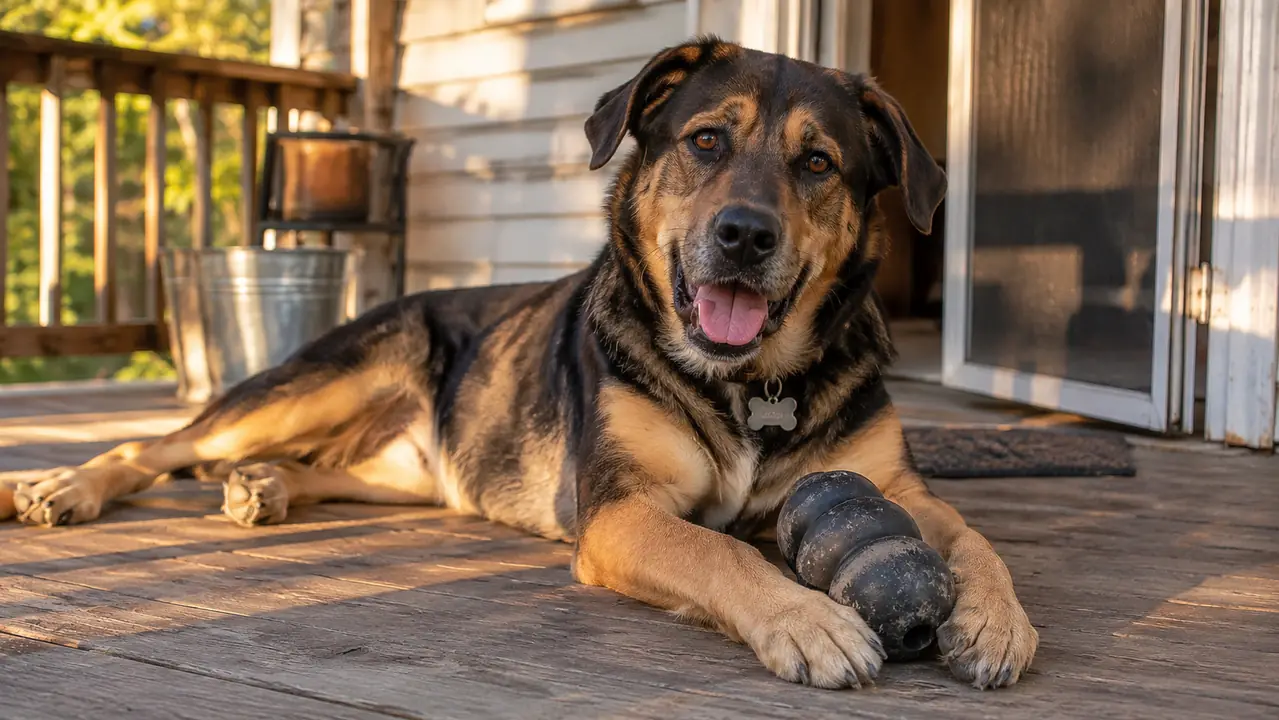
Gunner hits his wall at four in the afternoon. You would not guess it at three. At three he is flat on the rug with his feet twitching. At four he is up, pacing the hallway, nudging my elbow off the armrest, and staring at the back door like I have personally locked something away from him. He is a six-year-old boxer mix, about 68 pounds, and he has more engine in him than a dog his age ought to have. If that sounds like your house, the problem is probably not that your dog is badly behaved. The problem is that he is full of gas and has nowhere to put it.
I tried the obvious fixes first. Longer walks, which bought me about twenty quiet minutes and then reset. A tennis ball, which lasted one afternoon. A rope, which lasted two days and left a pile of string on the kitchen floor. What finally moved the needle was cheaper and duller than any of that: a heavy rubber chew with a hollow middle, stuffed with something he had to dig out. I have been running that routine with the KONG Extreme for a while now, and it does the one thing the walks never did. It gives him a job. A tired dog is not a dog that has run far. A tired dog is a dog that has thought hard about something.
The toy that turns a four o'clock meltdown into an hour of quiet
Natural rubber, built for X-Large dogs, with a hollow center made for stuffing. This is the piece of gear I reach for before I reach for the leash.
Amazon Check Today's Price on Amazon →Step 1: Match the Toy to the Jaw, Not the Number on the Scale
Most people size a chew by body weight, and that is only half the story. Gunner is 68 pounds, which puts him in a lot of large-dog gear, but his jaw is what decides whether a toy survives the week. The Extreme is built for X-Large dogs and listed at 5 by 3.5 by 3.5 inches and 11.99 ounces, and that weight is doing real work. A light toy gets picked up and flung. A toy with some heft makes the dog settle down and hold it, which is exactly the behavior you are trying to buy.
The rubber is the other half of it. This is natural rubber, the material KONG has been selling for decades, and it gives under a hard bite instead of cracking. I have watched Gunner destroy softer toys in a single evening, and I have watched him work this one for weeks. It has teeth marks on it and nothing else. The listing says made in America and water resistant, and both have turned out to be true in practice, which is not something I can say about every dog product in my garage.
The last thing I check is the bounce. The Extreme has an erratic, unpredictable bounce, so when it comes off the floor it does not travel in a straight line. That sounds like a small detail. It is not. A toy that bounces straight is a toy the dog solves in one afternoon. A toy that kicks sideways keeps him guessing, and guessing costs him energy. The first one I bought I held in one hand at the counter before I ever gave it to him, squeezing it to see how far it gave and how fast it came back. It came back slow. That told me more than the packaging did.
Step 2: Stuff It and Freeze It So the Work Lasts Past Minute Two
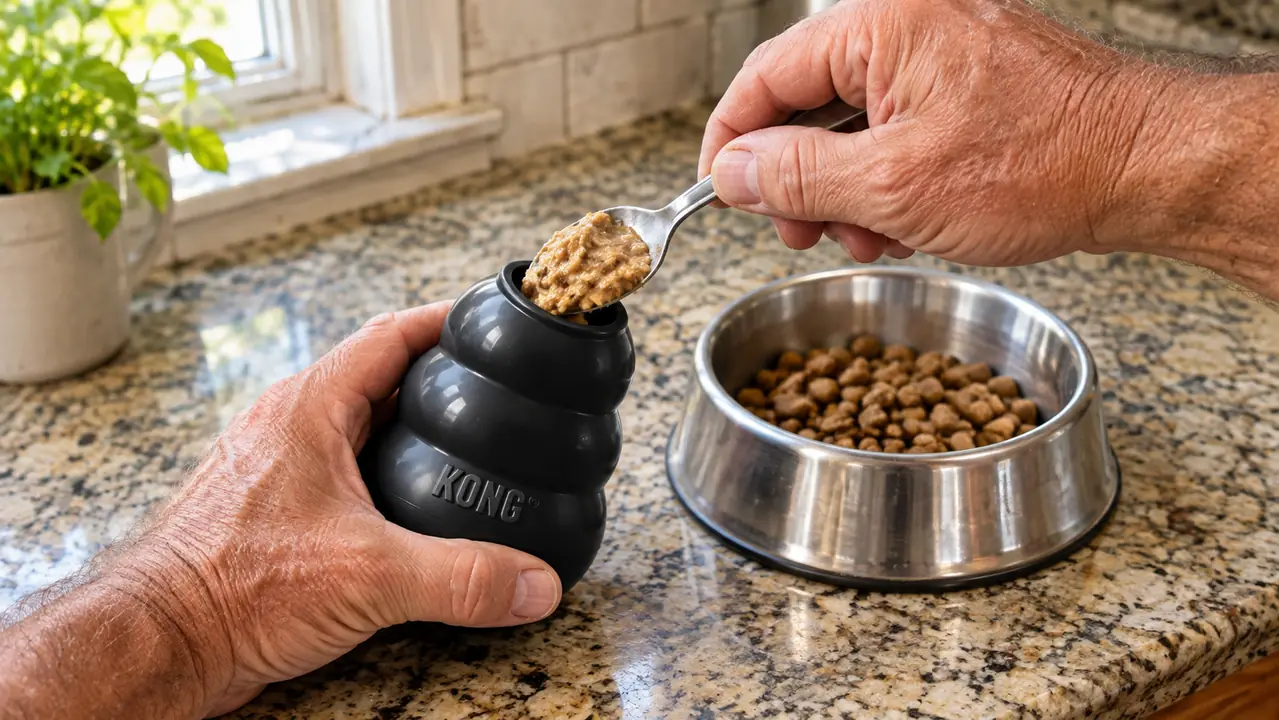
Here is where the hollow center earns its keep. That cavity holds kibble, peanut butter, or KONG Snacks and Easy Treat, and a stuffed toy changes the whole exercise from chewing into problem solving. I load mine at the kitchen counter, standing up, in about ninety seconds, which matters when your back is 61 years old and your dog is already spinning circles behind you.
Then it goes in the freezer overnight. A frozen stuffed toy is slower, colder, and far more work than a room-temperature one. Gunner will lie down with a frozen one and chip at it for twenty-five minutes without getting up. A warm one he clears in six. I timed both with the kitchen clock one Saturday, mostly because I did not believe the difference was that large. It was. If you only take one thing from this article, take that one. The freezer does more for a high-energy dog than a second walk does.
I keep three in rotation and stuff them all on Sunday night, so there is always one frozen and ready. I have two small rules. Nothing goes in the cavity that a vet would object to, and nothing goes in that I would not eat myself. Rinse the toy under the tap between rounds. It is water resistant, so a quick wash is all it needs, and it is unscented, which means it does not leave a smell in the freezer next to the ice cream.
Step 3: Use the Bounce to Run Him Tired, Not Just to Play Fetch
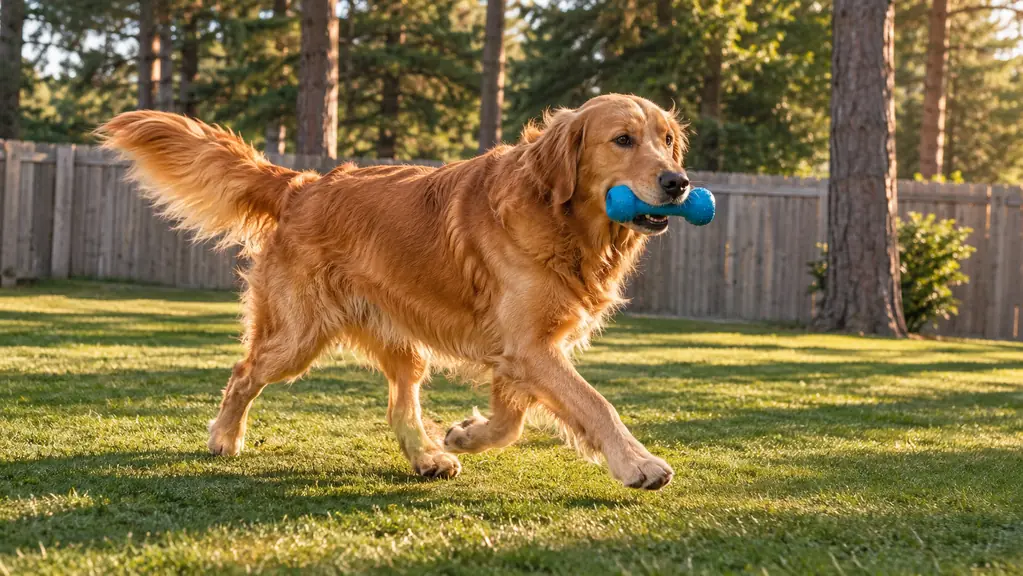
A straight-down-the-yard fetch is a sprint, and sprints are over in three minutes. The way to actually drain a dog is to make him brake, turn, and recalculate. I throw the Extreme low and at odd angles so it lands and skitters sideways off the bounce. Gunner has to read it, adjust, and chase again. Eight or ten of those in the back yard and he is done arguing about anything. My best throws are the ones that hit the corner of the patio slab first, because the bounce off concrete is where it gets truly sideways and he has to plant a foot and reverse.
I also use it as a training reward, which stacks the physical work on top of the mental work. Sit, wait, release, then the toy goes. He will hold a stay now that he never held before, because the chew is worth more to him than a piece of kibble and he knows it. Fifteen minutes of that in the yard and he comes inside and lies down on his own.
One caution, and it comes from experience rather than a warning label. Throw it away from windows and away from anything with glass, because the bounce is genuinely unpredictable and it carries some weight behind it. I have put one off the side of the house. My wife has not let me forget it.
Twenty minutes of chasing a ball straight down the yard wore out his legs. Ten minutes of working a stuffed KONG Extreme wore out his whole afternoon.
Step 4: Build a Three-Session Day Around His Energy Curve
One big session does not fix a whole day, and I learned that the slow way. What works in this house is three smaller hits. Right after his morning out, he gets a frozen stuffed toy while I have my coffee. That is my quiet hour, and it costs me nothing but the ninety seconds I spent the night before.
The middle session is the important one, because it lands before the four o'clock wall instead of after it. If I catch him at three-thirty, before he starts pacing, ten minutes in the back yard with the erratic bounce is enough to head the whole thing off. If I wait until he is already wound up, everything takes twice as long. Timing beats effort with this dog every single time. I keep a note on the refrigerator door with three-thirty written on it, and I moved a kitchen timer onto the counter, because I am the one who forgets, not him.
The last session is the wind-down, and it is the one I protect most. Gunner has a little stiffness in his back hips on cold mornings, and a hard running session late in the day is not kind to that. So the evening is a stuffed toy on the rug and nothing else. Lying down, working his jaw, no impact on the hips and no charging around the living room. He settles faster after that than after anything else I have tried, including the long walks I used to be proud of.
Step 5: Rinse It, Check It, and Retire It on Schedule
A chew toy gets nasty faster than people realize, especially when it lives in a peanut butter cavity. Mine gets a rinse and a scrub every few days and a proper wash once a week. It is water resistant and unscented, so it comes out clean and does not hold an odor. Two minutes at the sink saves you a dog with a sour mouth and a toy you do not want to touch. I use a bottle brush on the inside, the same one I use for travel mugs, and it reaches the bottom of the cavity where a sponge will not.
Then I check it. Run a thumb around the openings and look for nicks, splits, or a chunk missing. Natural rubber gives a long time, but it is not immortal, and a dog Gunner's size will eventually find the weak spot. Any toy that starts to come apart goes in the trash that same day. Swallowed rubber is a vet bill and a bad night, and no chew is worth that.
I keep two KONG Extreme toys in the rotation so one can be washed and frozen while the other is in use, and I replace them when they fail inspection rather than when they vanish under the couch. That is the whole maintenance routine. Rinse, inspect, retire. It takes less time per week than one of the walks I used to take him on.
What Else Helps
The chew handles the bulk of the work in this house, but it is not the only lever. Scattering his kibble in the grass so he has to hunt for it burns ten minutes for free. A cardboard box with a few treats inside and the flaps folded over will occupy him while you eat lunch. Neither one is fancy, and neither one costs much, and together they fill the gaps between chew sessions.
The other thing that helped was teaching him a settle. Not a trick, just a spot on the rug and a word that means stay there until I say otherwise. It took about three weeks of short, boring repetitions. Now when he gets the word he goes to the rug and lies down on his own, and the difference between a dog who can settle and a dog who cannot is the difference between a reasonable afternoon and a long one.
And keep the walks. I am not telling anyone to skip them. But a walk is a floor, not a solution, and once I stopped expecting the walk to do all the work I stopped being disappointed by it. The exercise tires his body. The chew tires his brain. A high-energy dog needs both, and the brain part is the part most of us leave on the table.
Give him a job before he invents one of his own
One heavy rubber chew, stuffed and frozen, has bought me more quiet evenings than every other toy in the bin combined. If your dog is chewing the furniture at four o'clock, this is where I would start.
Amazon Check Today's Price on Amazon →