
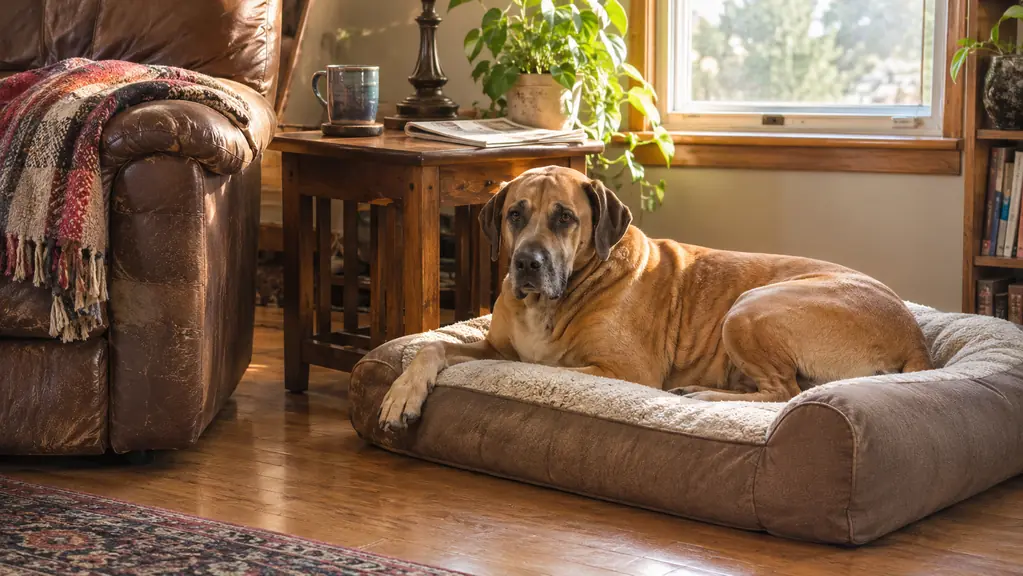
Gunner is a 6-year-old boxer mix, 68 pounds, and he has flattened every dog bed I have bought him. He does not shred them. He does something quieter than that. He walks a tight circle, drops his weight, and grinds the filling down until the thing is a mat with delusions. I have thrown out three beds in two years. So when I ordered the Bedsure orthopedic dog bed, I had no expectations worth mentioning. I figured I would be shopping again by spring.
I have run this one for months now, in a one-story house outside Greenville, South Carolina, with a fenced back yard and a dog who sheds year round and digs at anything soft. Gunner also has a touch of stiffness in his back hips on cold mornings. Not bad enough for the vet to do much about it. Bad enough that he takes a second to get up off the hardwood. That is the reason I went looking at orthopedic beds in the first place. Here is what held up, what did not, and who I would hand this bed to.
The Quick Verdict
Months under a 68 lb dog that ruins everything, and the pad still springs back. The cover washes and goes back on without a fight. The raised edge is the real reason to buy it.
Amazon Check Today's Price →The Bed That Came Back After Months Under a 68 lb Dog
Four-sided bolster, egg-crate foam pad, cover that zips off and washes cold. Measure your dog instead of trusting the weight number on the listing, then have a look at today's price.
Amazon Check Today's Price on Amazon →How I've Used It
The bed went down in the corner of the living room, on the hardwood, next to the recliner where I drink my coffee in the morning. That is already Gunner's spot. I did not do anything clever with it. I set it down, put his old blanket on top for two days so it carried his smell, then took the blanket off and let him decide.
First week he used it maybe an hour a day. Second week it became the default. Now he is on it most afternoons and he sleeps there more nights than not. Which is not the same as sleeping through the night, because he is six and he hears things, but the bed is where he goes back to.
I move it around more than I expected to. It is 5.34 pounds and 35 by 25 inches, so I can grab a corner with one hand and carry it into the bedroom or out to the truck. It has been on the porch while I was staining a shelf, in the back of the pickup on a vet run, and in the shed where I keep the golf cart while I swept it out. A heavier bed would have stayed in one room, and Gunner would have laid on the floor instead.
Night is where it earned its keep. The bed lives in the living room, but on the cold nights in January I carried it into the bedroom and put it on the floor on my side. He slept there until about four in the morning, which for him is a full night. Before this he would get up twice and click around the house on the hardwood. I do not have a scientific measure for that. I have a house that is quieter at two in the morning.
What I have not done is baby it. He kneads before he lies down, every time, front paws working like he is making bread. He digs at the front edge when he wants me to look up from the paper. Months of that is the actual test. A photograph of a dog looking comfortable on a brand new bed tells you nothing.
The Cold Morning Test
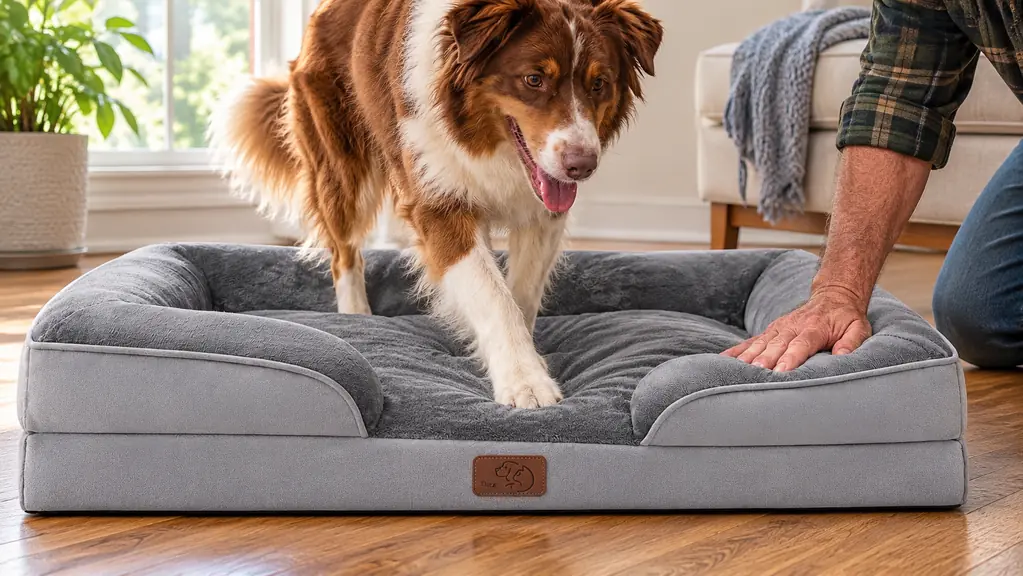
The reason I bought an orthopedic bed and not another fluffy donut is the way Gunner lies down on a cold morning. Watch an older dog do it sometime. He does not flop. He lowers his front end first, then tips over sideways, and if there is nothing behind him the back end drops the last few inches onto the floor. That is the part that hurts.
This bed has a raised edge on all four sides. The listing calls it a sofa style and that is close enough. Gunner puts his chest against the front edge and his hip against the side, and the drop is about an inch instead of four. It is a small thing to watch and a large thing for him. He used to circle three times and think about it before committing. Now he walks over and goes down.
The pad in the middle is egg-crate foam, which is the part doing the work on his hips and spine. It is not memory foam and it does not mold to him. It is a couple of inches of textured polyurethane that spreads his weight out instead of letting it land in one place. For a dog with mild stiffness, that is enough. It is not enough for a dog with a real diagnosis, and I would not pretend otherwise.
For the first two weeks I was not sure it was doing anything. He used it, he seemed fine, and I could not tell you whether his hips felt better because I am not inside his hips. What changed was the standing up. On the old flat bed he would push himself up with his front legs and rock a couple of times before the back end came along. On this one he stands on the first try most mornings. That is the only evidence I have and it is enough for me.
One honest note on the raised edge. It compresses. It is filled with the same polyester as the rest of the bed, so a determined dog can push it flat. Gunner at 68 pounds leaves it about half its height when he leans on it. A 90 or 100 pound dog will squash it down to a speed bump. The bolster helps, it does not restrain.
Sizing: Measure Your Dog, Not the Weight Number
The listing offers nine sizes from 20 inches up to 52 inches, and the one I have is 35 by 7 by 25 inches. Gunner at 68 pounds fits on it with room to spare. He can curl up or stretch out and his chin still lands on the edge. I expected him to hang off the end and he does not.
The weight guidance on the Bedsure product page is a mess, and I say that as someone who reads the spec sheet before he buys anything. The attributes list a maximum weight recommendation of 30 pounds, while the description talks about dogs up to 150 lbs in the bigger sizes. Those two numbers cannot both be right. I ignored them and measured instead. Nose to the base of the tail, while he is stretched out flat, then add four inches. Gunner measures 34 inches stretched and the 35 inch bed is exactly right, not roomy. If your dog sprawls when he sleeps, go up a size.
One more thing worth knowing before you order. The foam comes compressed and takes a day or so to plump up after you unroll it. I set mine out on the porch in the sun for an afternoon and it was fine by evening. If you open the box and it looks thin, give it a day before you decide you were sent the wrong thing.
Wash Day, Once a Month
Gunner sheds year round and he drools in his sleep, so the cover has been through the wash about once a month. The zipper runs around the underside. The cover comes off without me wrestling the foam out of it, and the foam stays in one piece. That last part is why I would buy this bed again. I have owned a bed where the inner cushion soaked through and clumped into a lumpy brick, and there is no coming back from that.
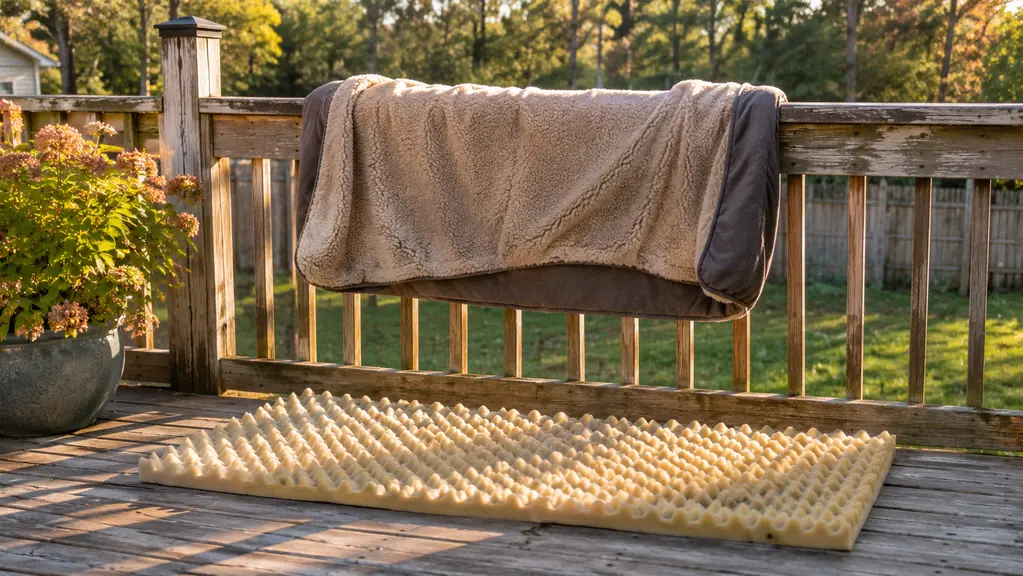
Cold water, hang the cover over the porch rail, back on the bed by late afternoon. It goes back on with the pad flat and the corners lined up on the first try, which I did not expect and still do not take for granted. The listing says the cover is waterproof. I have not tested that with a hose, but I have tested it with a wet dog who came in from the yard and went straight to the bed, and the foam underneath was dry.
The foam itself does not go in the machine. It gets aired on the porch and pressed flat with my hand, and that is the whole of its maintenance. If you want a bed you can throw in the dryer whole, this is not that bed.
The Foam, Months In
Here is the part I would want to read if I were you. The foam has softened. Not failed, softened. There is a shallow dip in the middle where his hips land, maybe half an inch deep, and it has not gotten deeper in the last month. Egg-crate foam does that. It is not a mattress and there is no warranty worth talking about on the pad itself.
I lift the cover every couple of weeks and press the Bedsure pad with my palm. It still springs back. It is still rectangular. No clumps, no split seams, no polyester dust on the floor under it. For a bed I expected to replace before summer, that is a result I will take.
I have not put a number on how long it will last because I do not know. What I can tell you is that the failure on the beds I threw out happened fast, inside two months, and this one is well past that mark with a shallow dip and nothing else wrong with it. If it gives out at a year, I will say so.
On the old flat bed he rocked twice before the back end came up. On this one he stands on the first try.
What I Liked
- Held its shape for months under a 68 lb dog that flattens everything else, with only a shallow dip where the hips land
- The cover zips off, washes cold, and goes back on with the pad flat on the first try
- Waterproof cover kept the foam dry through a wet dog and a monthly wash
- The four-sided edge gives a stiff dog something to lower himself against, and the standing up got easier
- 5.34 pounds and 35 by 25 inches, so it moves room to room one-handed
Where It Falls Short
- The foam has softened in the middle. It is not going to feel new forever
- The weight guidance on the listing contradicts itself, so you have to measure your dog
- The raised edge compresses under weight and will not stop a determined digger
- Only the cover can be washed. The foam gets aired, not laundered
Who This Is For
This bed fits a dog between roughly 40 and 75 pounds with mild stiffness, the kind that shows up as a slow stand on a cold morning rather than a limp. It fits an owner who wants to unzip a cover and have it clean the same day. It fits anyone who has thrown out two or three flattened beds and wants one that gets them through a year without another trip to the store.
It also fits a retired household where the dog bed has to move. If you want one bed that lives in the living room, goes in the truck, and comes back inside, the weight is what makes that possible. I am 61 with a back that reminds me about it, and I can carry this thing one-handed across the house.
Who Should Skip It
Skip it if your dog is a serious chewer. Gunner digs but he does not eat fabric. A dog that eats fabric will get through the cover and then through the foam, and no bed of this kind survives that. Skip it if your dog is over 90 pounds, or a digger who works the same spot every night, because the foam will take a permanent dent and the raised edge will flatten into a suggestion.
And skip it if you want a bed that swallows your dog. Some dogs want to be buried in filling and some want to lie on top of it. Gunner is the second kind, which is why this works for us. If yours is the first kind, buy something deep and save yourself the return.
If Your Dog Takes a Second to Stand Up, Start Here
Measure nose to base of tail, add four inches, order that size, and give the foam a day to plump up before you judge it. The full size range and today's price are on the listing.
Amazon Check Today's Price on Amazon →