
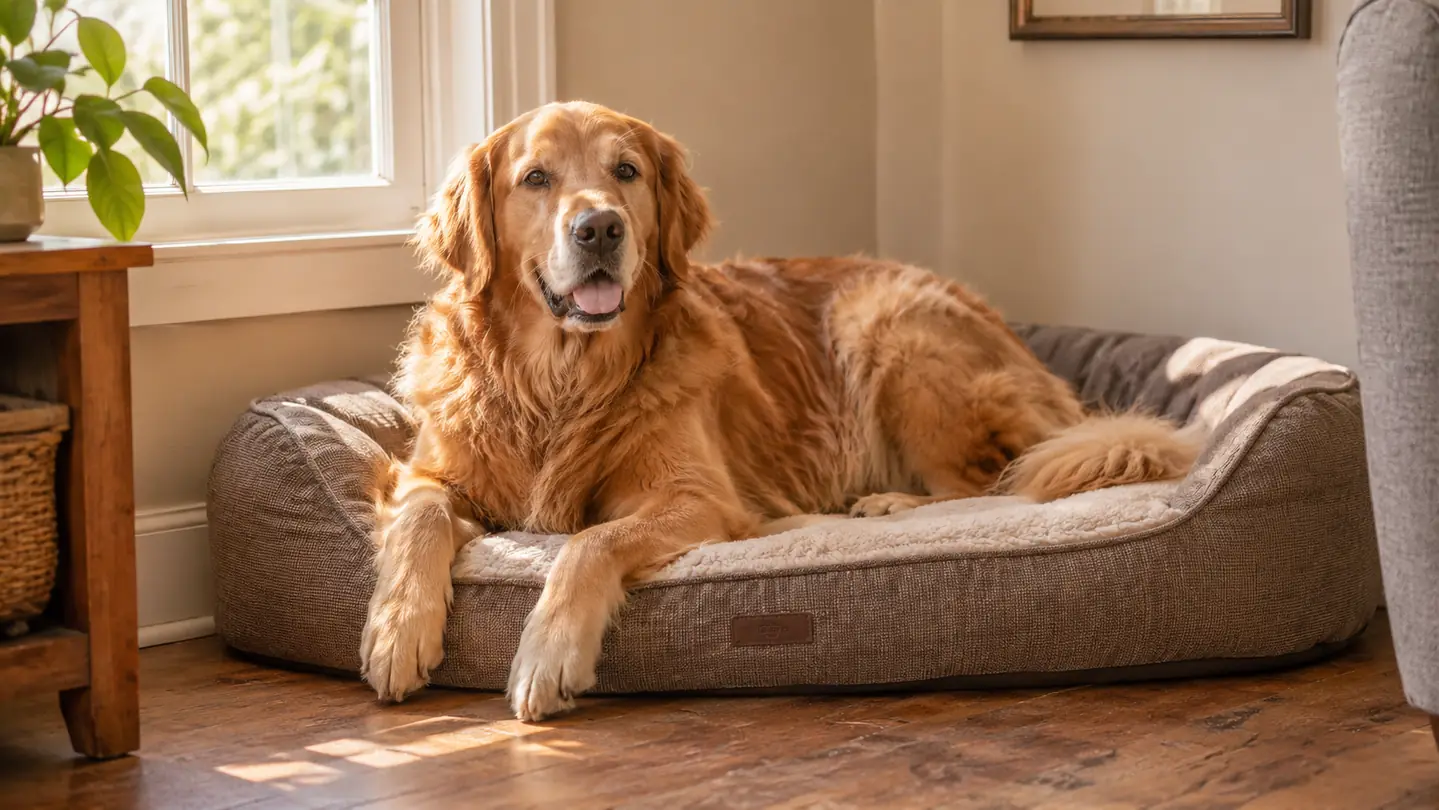
Gunner is six years old, sixty-eight pounds, and a boxer mix, which means he has never once walked anywhere when running was an option. Then we got two cold mornings in a row last January, and I watched him get up off the floor like a man twice my age climbing out of a recliner. Back hips first, front legs after, and a long pause in the middle where he seemed to be deciding whether standing was worth the trouble. I am Wade Satterfield, sixty-one, medically retired, and we live outside Greenville, South Carolina, in a one-story house where the floors are hardwood and cold from November through March.
He had a flat bed before this. Thin, cheap, the kind you buy without thinking about it, and it did exactly one thing: kept him off the boards by about an inch. What he needed was foam with enough give to take the weight off his elbows and hips. I replaced it with the Bedsure orthopedic dog bed in the largest size that would fit the corner of the den, and I have now watched him use it every single day for the better part of a year. This is the list I would give a friend who asked me whether the Bedsure bed was worth the swap.
The bed Gunner picked over the couch, six days running
Orthopedic egg-crate foam, a bolster on all four sides, and a cover that unzips and goes in the machine. Nine sizes from twenty inches up to fifty-two, so measure your dog and order the number, not the breed.
Amazon Check Today's Price on Amazon →The foam gives at the elbow instead of at the joint
The first thing you notice is not the height. It is the give. Push your palm into the middle of this bed and it sinks half an inch and comes back. The insert is orthopedic egg-crate foam, the same idea as the topper I put on my own mattress after knee surgery. On bare hardwood, a dog's elbow takes the whole front half of his body weight every time he lies down. With the foam under him, that weight spreads out over a wider patch. Gunner still takes his time going down. He just does not grunt on the way anymore.
A four-sided bolster gives him something to brace on
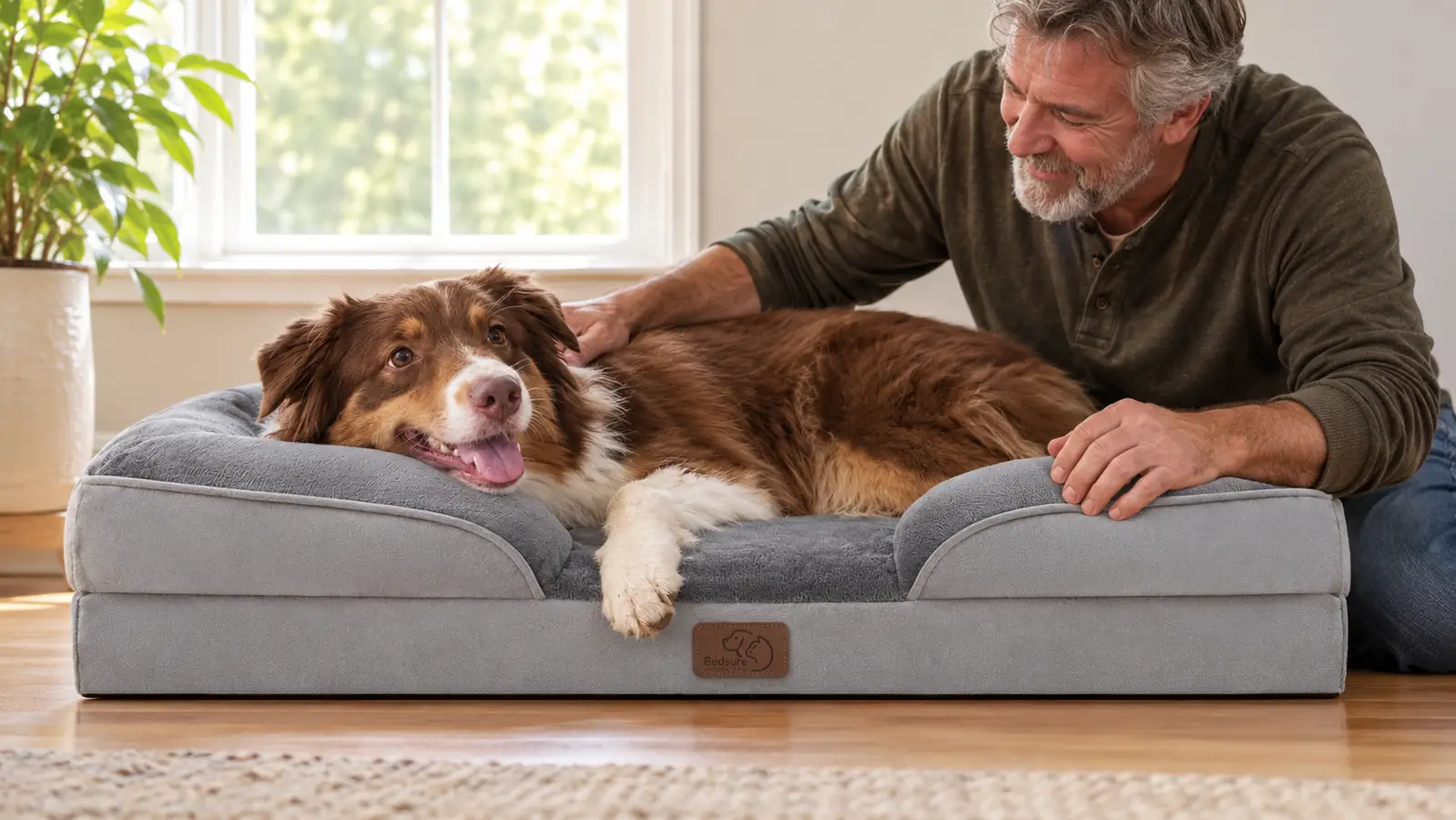
Lying down is the easy part. Getting up is what hurts. The bolsters run all the way around this bed, and Gunner worked out within about a week that he can shove a shoulder into the side rail and use it the way I use the handrail on my porch steps. Chin over the edge first, then push, then he is up. I did not teach him that. The rails also give him a place to park his head, which he does with his chin hanging over the side and one eye on the kitchen door.
The cover unzips, so the bed does not get retired early
Here is what kills dog beds in my house. Not the foam. The smell. Gunner sheds year round and he is not careful about what he tracks in on his feet. This cover unzips and goes straight in the machine while the foam stays out of the drum. I have washed it six or seven times since spring and the zip still lines up straight, which is more than I can say for the last bed I owned.
The waterproof layer is why the insert is still a block
Every bed I have bought that claimed to be washable meant the whole thing went in the machine and came out shaped like a taco. This one has a waterproof layer between the cover and the foam, and the foam insert itself never gets washed. That is the detail I actually care about. Gunner had a rough night in February and the cover took the hit, not the cushion. I rinsed it in the utility sink before it went in the washer and the insert underneath was dry when I checked it.
Nine sizes let you measure instead of guess
Bedsure makes this bed in nine sizes, from twenty inches up to fifty-two, and I want to be plain about this one: get a tape measure out. Nose to the base of the tail, then add a few inches so the dog can stretch. Gunner measures about thirty-four inches stretched out, and the large rectangular bed at thirty-five by twenty-five by seven fits him with his chin on the rail and his back legs still on foam. If you have a ninety pound lab, you want the size above mine, not mine.
Seven inches high means he steps on instead of climbing
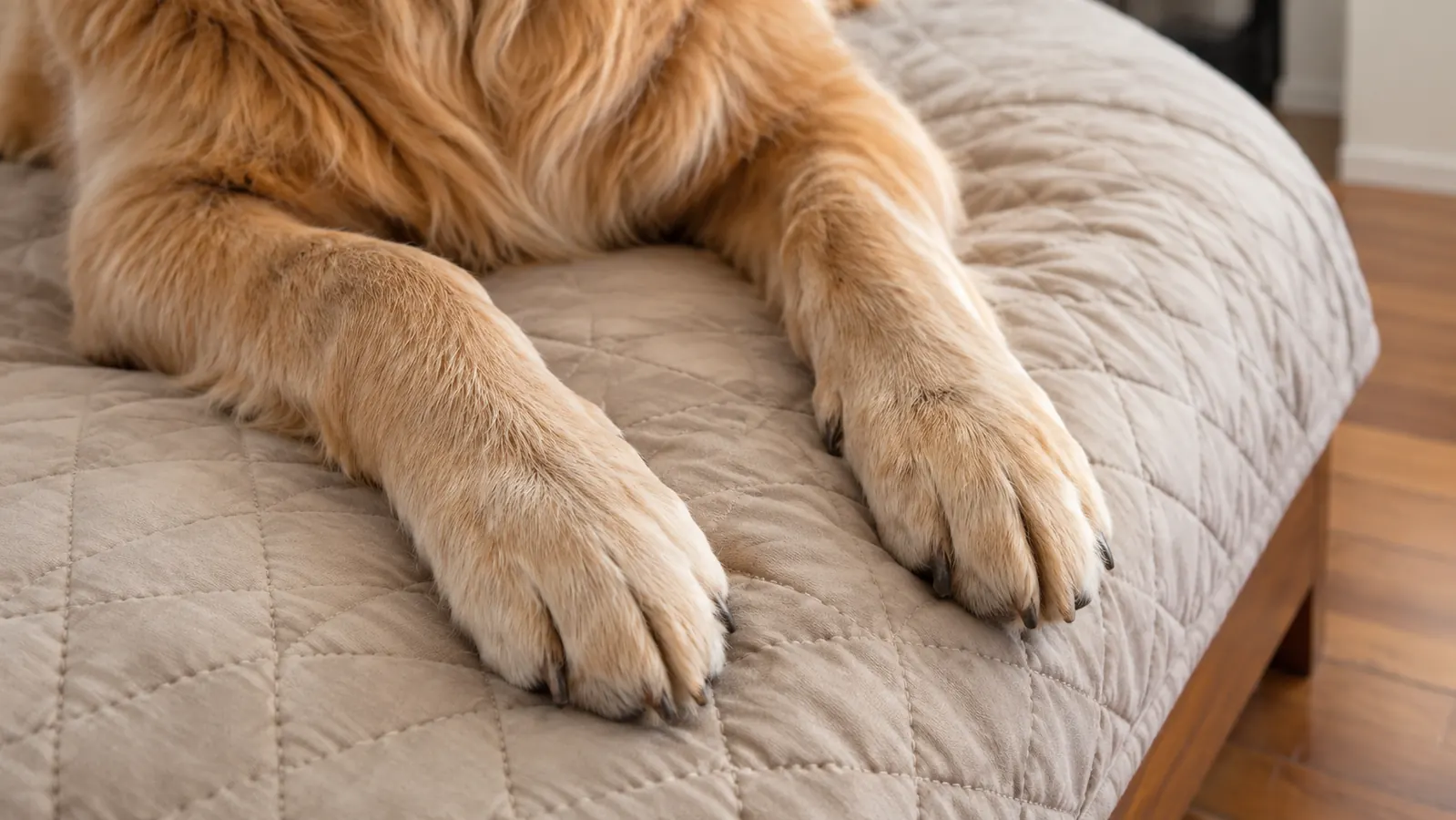
The rail sits about seven inches off the floor. That is roughly curb height. Gunner steps over it without breaking stride. The beds I looked at with tall walls and a ramp bolted to the side were solving a problem he does not have, and they ate twice the floor space in a den that is not large to begin with. My knees are also a consideration here, and a bed I do not have to step over at night is the bed that stays in the room.
A rectangle fits flat against a wall, which is where he wanted to sleep
The bed is rectangular with the bolster running the full perimeter, so I can push one long side flush to the baseboard and he still has a rail on the other three. Dogs pick a corner and back into it. This lets Gunner do that without his rear end sliding off onto the floor, which is exactly what happened with a round bed I tried in the fall and gave away in the spring.
The rail doubles as a headrest for stiff-side-down naps
Gunner sleeps on his right side nearly every time, and that is the hip that bothers him. On the old flat bed his head hung off the edge and his neck sat at an angle all night. With the bolster he rests his chin on the rail and his spine stays closer to level. I am not a vet and I am not going to pretend I can measure that. What I can tell you is that he gets up smoother in the morning than he did in December.
Cold mornings start with him on the bed instead of pacing the hall
I keep the thermostat at sixty-six overnight. When it drops into the thirties outside, Gunner used to walk the hallway before he would settle. Now he goes to the bed, turns twice, and is down. I think the foam holds a little of his own warmth instead of letting it leak into the floorboards. Whatever the reason, I get to drink my coffee while it is still hot, and that has not happened in three winters.
It replaced three things I almost bought instead
Before this I had a list: a set of pet stairs for the couch, a heated pad, and one of those crib mattresses people cut down for dogs. I bought none of them. The bed sits on the floor, so there are no stairs to trip over at two in the morning, and the foam does the job the pad was supposed to do. One piece of gear instead of three is a fair trade at my age. My back is the thing I am really protecting here, and fewer things to move around the den suits me.
What I'd Skip
Two things. First, do not order by breed. The listing says large, the chart is in inches, and the only number that matters is the one you get with a tape measure. I nearly ordered a size down and Gunner would have been hanging off the end of it. Second, do not expect the bolster to stay firm forever. After about eight months of a sixty-eight pound dog leaning on the front rail every day, that rail has softened and no longer holds its shape the way it did in March. It still does the job. It is just not the same rail. And if your dog is a determined chewer, this is not the bed for him. Gunner put a small pull in the corner of the rail in the first month before I redirected him to a toy, and that pull is still there and I still notice it every time I walk past.
The rail is the part that matters. He hooks his chin over it, pushes, and he is up. I did not teach him that.
If your dog braces to stand up, this is the bed I would buy again
Same size, same foam, still on the floor of the den ten months in. Measure nose to tail base, add a few inches, and order that number.
Amazon Check Today's Price on Amazon →