
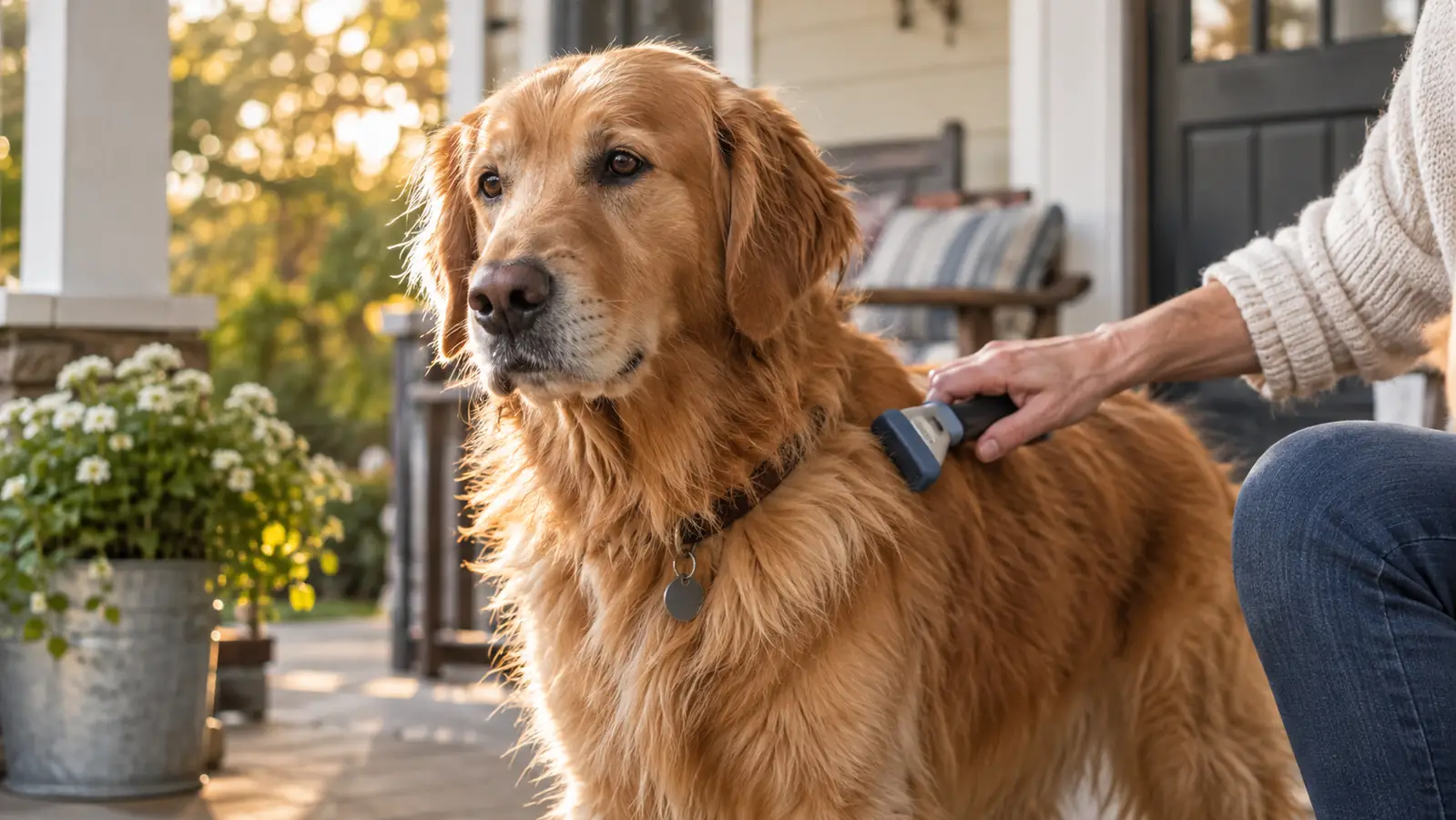
Short answer first: these two tools are not competitors. They are different jobs. If your dog sheds year round and you are tired of the broom, the FURminator Deshedding Tool does the heavy lifting and a slicker brush keeps the coat tidy in between. I ran both on Gunner, my 6-year-old boxer mix, for six weeks, same ten minutes, same dog, same patch of floor. The difference showed up in the vacuum canister, not in how the brush looked sitting on the shelf.
Gunner is about 68 pounds of year round shedder. His coat is short on top and there is a stubborn undercoat underneath it that lets go in spring and again in the fall, and never entirely stops. Short hair over a dense undercoat is exactly what the FURminator Large Dog Undercoat deShedding Tool for Short Hair was built for, and it is the first grooming tool I have bought in years that changed the amount of hair in my house. I still keep a slicker brush in the drawer. I just quit expecting it to solve the problem.
| FURminator Deshedding Tool | Slicker Brush | |
|---|---|---|
| Coat it suits | Short hair on dogs over 50 pounds, with a real undercoat | Any coat, strongest on medium to long fur |
| What it reaches | Through the topcoat to the loose undercoat | The surface of the coat, tangles and already-loose hair |
| Hair volume per session | Handfuls in a few passes down the back | Light pickup, needs many passes in the same spot |
| Cleaning | Push the FURejector button and the hair drops off the blade | Pick hair out of the pins by hand |
| Build | Metal handle, stainless steel bristle, 7.84 ounces, 2 by 6.5 by 8.75 inches | Varies widely, plastic bodies are common |
| Comfort on a sensitive dog | Blade edge, wants a light hand and a calm dog | Thin pins that flex against the skin |
| Mats and small tangles | Not a mat breaker, skip matted coat | Works small tangles loose and fluffs the coat |
| Legs, feet, face and tail | Head is broad, meant for the body | Small enough to finish the edges |
| Small or squirmy dogs | Large size is a poor fit under 50 pounds | Easy to control on a small frame |
| Daily touch-ups | Once a week is plenty | Fine for a light daily once-over |
Where FURminator Wins
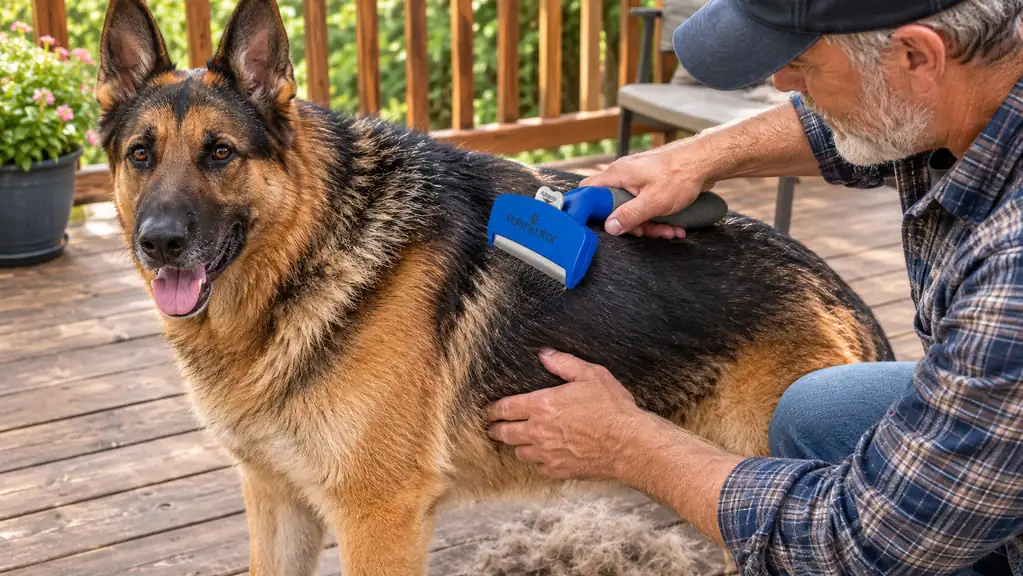
Volume is the first win and it is not close. On a short coat, a slicker brush grabs what is already sitting loose on the surface, and the dog looks great for about an hour. The FURminator reaches through the topcoat, which is the whole reason the tool exists, and pulls the undercoat hair that was on its way out anyway. My first session produced a pile the size of a softball, and I had brushed Gunner with the slicker the day before. That pile is the argument, and there is no polite way around it.
The second win is effort, and at 61 with a back that files complaints on cold mornings, effort is the whole ballgame. The head is built for dogs over 50 pounds and Gunner is 68, so each stroke covers real ground instead of needing five passes over the same six inches. Back, both flanks and the hindquarters take me about twelve minutes and I am standing up straight the whole time. With the slicker it was twenty minutes of short strokes and I still had hair on the couch when I finished. Multiply that by every Sunday since March and it adds up to a couple of hours I got back.
The third win is cleanup, which almost nobody mentions. The FURejector button pushes the collected hair off the blade in one motion and you are done. A slicker brush makes you sit there and pull hair out of the pins with your fingers, and if you skip that part the brush quits working, which took me two worn-out brushes to figure out. The handle is metal and the bristle is stainless steel, 7.84 ounces and 2 by 6.5 by 8.75 inches, so it sits in the hand like a tool instead of a toy. Over six weeks I figure I saved myself an hour of picking hair out of wire, and I did not miss a minute of it.
Where a Slicker Brush Wins
Skin comfort, plainly. Slicker pins are thin and they flex against the skin, and on a dog that does not love being handled near the hindquarters that flexibility matters. Gunner tolerates the slicker longer before he walks off. The deshedding tool needs a light hand and a cooperative dog, and on the morning after a cold night his back hips are stiff and he is not always cooperative. When he is sore, the slicker is the only one of the two that gets used that day.
The edges also belong to the slicker. Legs, feet, face and tail are slicker brush work. The deshedding head is broad and the blade is meant to travel along the body with light pressure, not down a pastern or across a muzzle. I use the slicker on Gunner's legs every single time before I touch the deshedding tool, and if I skip it his front legs look rough for a week. That is not a small thing when the whole point is a dog that looks cared for at the door.
Last, tangles and small dogs. If the coat has small knots in it, the slicker works them loose. The deshedding tool does not break mats, and dragging a blade across a matted patch is how you teach a dog to hate the sight of you holding anything. And if your dog is under 50 pounds, the large size is simply the wrong fit and a slicker is easier to control on a small frame. Deal with the knots and the small dogs first, then reach for the bigger tool.
The tool that emptied my vacuum canister
FURminator Large Dog Undercoat deShedding Tool for Short Hair. Metal handle, stainless steel edge, and a button that dumps the collected hair in one push. It is the one I reach for first every Sunday.
Amazon Check Today's Price on Amazon →How I Ran the Test
I started on a Sunday in March, which outside Greenville means the coat is already coming out in handfuls. I brushed Gunner with the slicker first, ten minutes, both sides, then swept up what came off the floor and dumped it in a bucket by the garage door. The next day I used the FURminator for the same ten minutes, same order, same patch of floor, and swept that into a second bucket. I kept that rotation going for six weeks so I could compare the piles without guessing. I weighed nothing and measured nothing beyond the eye test, because the eye test is what actually decides whether you keep using a tool.
Nothing about this was scientific. I am not a groomer and I am not going to dress it up as a study. Same dog, same schedule, same ten minutes, and I looked at what ended up on the floor and in the vacuum canister. What I noticed by week two was that the slicker bucket stopped growing, because the slicker was picking up the same loose hair over and over, while the other bucket kept filling. That is the difference between surface work and undercoat work, and it was visible in two plastic buckets on a garage floor.
Two rules came out of it. Brush a dry coat, because a damp coat bunches up and the tool grabs nothing, and I wasted one Sunday morning learning that after a walk in the rain. And go light. The first week I leaned on Gunner's flank the way you push a vacuum, and he told me about it by leaving the room and standing at the back door. Light strokes, let the edge do the work, and now he stands there for the full twelve minutes without being asked. If your dog leaves, you are pressing too hard, and the fix is in your wrist, not in the tool.
Six weeks in, my lint roller refills lasted about three times as long. That is the number I keep coming back to.
Why a Short Coat Fools People
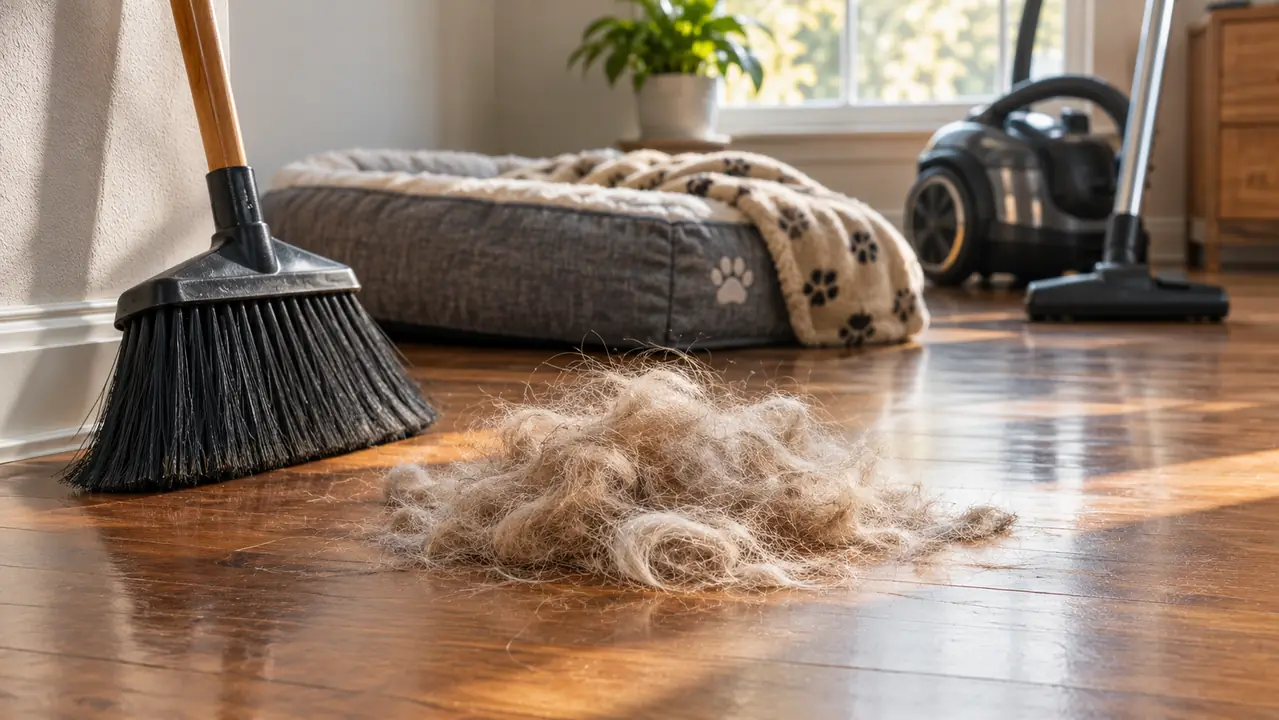
People see a short coat and figure there is nothing to brush. It is the other way around. A short topcoat hides a dense undercoat, and that undercoat is what ends up on your baseboards, your couch and the floor mat in the truck. Long haired dogs drop hair in clumps you can see and pick up with one hand. Short haired dogs drop single hairs that work their way into fabric, and those are the ones that survive the vacuum and come back out on the next person who sits down.
That is why a slicker brush feels like it is working when it is not. It lifts surface hair, the coat looks smooth for an afternoon, and by evening the couch is furred again. I spent two years blaming the vacuum. The FURminator is designed for this coat type on a dog over 50 pounds, and the blade is meant to reach the loose undercoat rather than polish the top. Once that clicked, the weekly routine stopped feeling like a chore and started feeling like maintenance, the same way changing the oil in the truck stopped feeling like a project.
The day it really landed was a Saturday in April when my daughter stopped by with her two kids. Gunner met them at the door, did his usual spinning routine, and within five minutes there was hair on both kids and on the couch they had claimed. I had slicker brushed him that morning. That afternoon I ran the FURminator on him for twelve minutes and got a pile I would not have believed if I had not swept it up myself. The kids came back the next weekend and the couch was fine. That is the whole review, really.
The Two-Tool Routine I Actually Use
A slicker alone could not keep up, and the deshedding tool alone left Gunner's legs and tail looking rough. So I use both, in that order, once a week. Slicker first on the legs, feet, face and tail, then the deshedding tool down the back, the flanks and the hindquarters. Twelve to fifteen minutes and I am done, then a sweep, then I do not think about it again until the next Sunday. The slicker takes about four minutes of that and the deshedding tool takes the rest.
The rest of the week I leave him alone. Over-brushing a short coat irritates the skin and there is nothing left to pull anyway, and I learned that in week three when I got enthusiastic and did him twice in four days. He was fine, but the second session produced almost nothing and his skin was pink for a day. When a session has to be short, the deshedding tool gets the time and the slicker gets skipped. That is the priority order I would hand to anybody with a dog shaped like mine.
The tool lives on the shelf by the back door next to the broom, which is a deliberate choice. If it is out of sight it does not get used, and that goes double for anything I have to go looking for in the garage. The FURejector button means I can do the whole job on the back porch and knock the hair straight into the yard, then hang the tool on a hook and go inside and wash my hands. The slicker stays in the same drawer as the nail clippers. Both are within arm's reach of the door the dog walks in, and that is the only reason either of them gets used every week without me having to plan for it.
Who Should Buy Which
Buy the FURminator if your dog is over 50 pounds, has short hair over a real undercoat, and sheds enough that you notice it on the furniture. Buy it if you are tired of the ten minute sweep before company comes over, or tired of a lint roller that quits by Tuesday. That is Gunner exactly, and it is the tool that changed the amount of hair in my house rather than just rearranging it from the floor to the couch.
If your dog has a long or curly coat, or almost no undercoat, the deshedding tool is not the first thing to buy and the slicker is. If your dog is small, the large size is the wrong fit anyway and I would not force it. And if the coat mats, work the mats out with a slicker or a comb before you go near a blade, because the deshedding tool will not break them and your dog will remember that you tried. Buy the slicker for the edges and the finish, either way.
Twelve minutes, once a week, a lot less hair on the couch
The FURminator Large Dog Undercoat deShedding Tool for Short Hair. Designed for dogs over 50 pounds, stainless steel edge, FURejector button for cleanup. If your dog looks like Gunner, this is the one.
Amazon Check Today's Price on Amazon →