
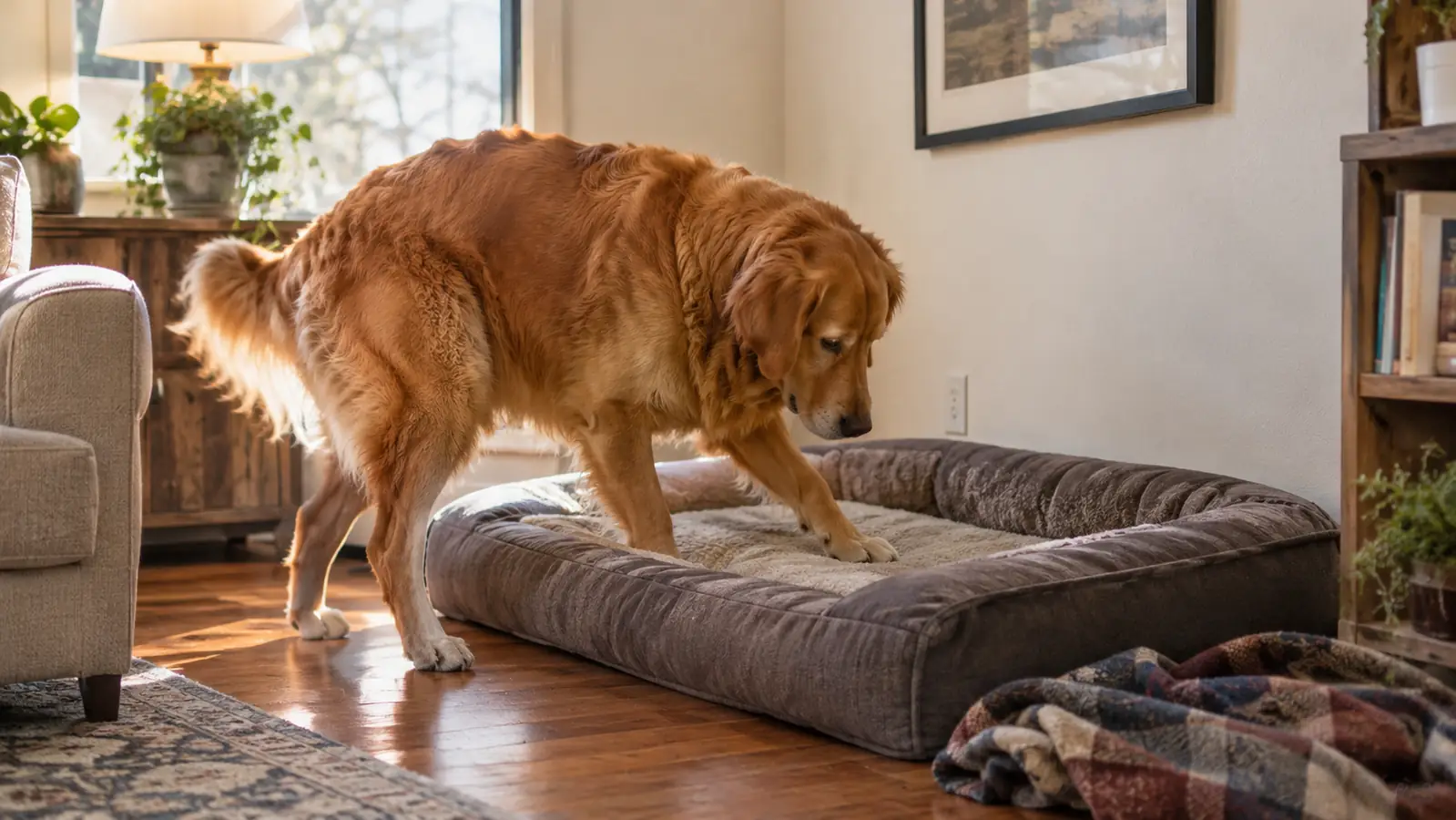
Gunner is a 6-year-old boxer mix, about 68 pounds, and he is rough on anything soft. In three years he has flattened two beds, chewed the corner off a third, and turned a fourth into what amounted to a very thin floor mat. So when I say I did not expect much from the Bedsure orthopedic dog bed, that is not modesty talking. That is a track record.
What follows is not the version where the product fixes everything. It is the review I wanted before I ordered: what the listing overstates, what it gets right, and the two things about this Bedsure bed that genuinely irritated me during the first month. Gunner still sleeps on it most nights. That is the short answer. The longer answer has some bumps in it, and you should hear those before you order one.
The Quick Verdict
A well-made bed for a dog that likes to curl against something, held back by contradictory sizing information and an egg-crate foam base that a heavy dog will compress within a couple of months.
Amazon Check Today's Price →The bolsters are the reason to buy it. The size chart is the reason to slow down.
Nine sizes run from 20 to 52 inches and the weight guidance on the listing contradicts itself. Measure your dog nose to tail base before you pick one.
Amazon Check Today's Price on Amazon →The Sizing Information Is a Mess, and It Matters
Here is the first thing nobody mentions. The product page for this Bedsure bed carries a maximum weight recommendation of 30 pounds in its specification panel. On the same page, the bullet points describe the bed working for a 15 pound dachshund up to a 90 pound lab, and nine sizes running from 20 inches to 52 inches for dogs up to 150 pounds. Those numbers cannot all be describing the same bed, and I could not find anywhere that the company reconciles them.
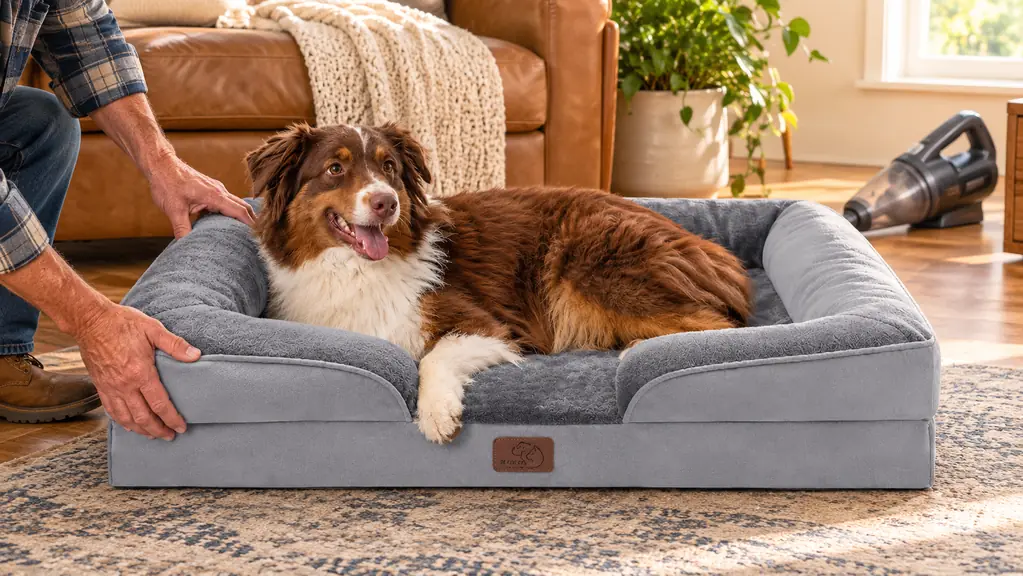
What I can tell you is what happened in my house. The 35 by 25 inch bed, 7 inches tall and about 5.3 pounds, is the one I ordered, and Gunner at 68 pounds fits it. He does not sprawl across it the way he did on a flatter, wider bed. He curls. If your dog likes to stretch out full length with his back legs out behind him, this footprint will feel tight, and I would go up a size or look at a different shape entirely.
So ignore the weight number in the spec panel and measure instead. Nose to the base of the tail, while the dog is standing. Add a few inches if he curls up, add more if he sprawls. That one measurement will tell you more about which of the nine sizes to pick than any chart on the listing, including the one the company printed.
The other thing the photos do not convey is how much of the bed the bolsters take up. Those four raised sides consume a good share of the total width, so a bed measuring 35 by 25 on the outside gives your dog noticeably less than that to lie on. I measured before I ordered and I was still surprised when it arrived. Gunner was not surprised, but then he is a dog and he does not measure things.
How I've Used It
The bed went down in the corner of the living room, on a wood floor, in late fall. Gunner is stiff in his back hips on cold mornings. Not enough that the vet is treating it, but enough that he takes a second to unfold when he gets up off the floor. That is the whole reason I was looking at an orthopedic bed in the first place.
The cushioning is egg-crate foam, polyurethane, under a polyester cover. It is not a dense slab. When I push my palm into it, it gives several inches and comes back slowly. That is the right feel for a dog that needs pressure taken off hips and elbows, and it is also the reason a 68 pound dog who digs in a circle before he lies down will work a hollow into the spot he favors.
First week, he ignored it. Second week, he slept on it a couple of hours in the afternoon. By the third week it was his default spot and he was carrying a chew toy onto it, which is the closest thing to a five-star review a boxer mix gives. The change I actually care about is the morning one. He gets up off that bed faster than he got up off the floor, and he does not do the slow three-second wobble first. That is not a cure for anything. It is a small improvement in a dog's morning, and I will take it.
It is also light, about 5.3 pounds on my kitchen scale, and I move it from the living room to the bedroom at night without thinking about it. That matters more than I expected. A heavy bed stays where you put it, and then the dog sleeps on the floor next to you instead.
One more thing about the first week. I did not leave him alone with it. Any bed with a removable cover and a foam insert is a gamble with a dog who likes to open things up, and Gunner is that dog. I watched him with it for seven days before I trusted it overnight. If you skip that step and come home to a shredded insert, that is not the bed failing.
The Bolster Is the Whole Point, and It Has a Cost
This is the original sofa-style design, four bolsters around the edge, and Bedsure makes a fair amount of noise in its listing about having created the category. Marketing aside, the bolsters do real work. Gunner rests his chin over the front one and wedges his back against the rear one, and that contact settles him. A dog that likes to lean on something gets more out of this bed than a dog that likes open space. That split has nothing to do with how big your dog is or how much you spend.
The cost is maintenance and reach. Because the sleeping surface sits down inside four raised sides, the interior is harder to vacuum than a flat mat, and every bit of the year-round shedding that comes off a short-haired dog collects in the seam where the bolster meets the base. I keep a hand vacuum by the door for exactly this. If you are not going to lift the bolster edge and run a nozzle around that seam once a week, this bed will look rough fast.
There is a second cost that shows up at night. When Gunner is fully asleep with his chin on the bolster, his back legs sometimes end up over the side and hanging. He does not seem bothered by it. It does mean the bed is doing its best work for the front half of the dog, and if yours is longer than mine you will notice that sooner than I did.
He gets up off that bed faster than he got up off the floor, and he does not do the slow three-second wobble first. That is not a cure for anything. It is a small improvement in a dog's morning.
The Foam, Two Months In
This is where an honest review earns its keep. After two months of nightly use by a 68 pound dog, there is a shallow dip in the egg-crate foam exactly where Gunner circles and drops. It is deep enough that I can feel it with my hand. It has not gotten deeper in the last three weeks, which suggests it settled rather than collapsed, but it is there and I am watching it.
The bolster foam has held up better than the base. The four sides still stand up on their own and have not gone flat, which was the failure I expected first. If the bolsters had collapsed in two months I would be writing a very different article, and probably a shorter one.
None of this is a defect. Egg-crate foam is exactly what it says it is: a fairly open, fairly light foam, and a heavy dog will compress it over time. If you want a bed that stays dead flat for years, you want a solid orthopedic slab, and you should expect a much heavier bed that you will not be dragging between rooms. That trade is the real decision here, not the brand name on the label.
What I Liked
- Four bolsters give a dog something to lean against, and Gunner uses all of them
- Egg-crate foam takes pressure off hips and elbows without feeling like a hard slab
- The cover comes off for washing, and the listing rates it waterproof
- Nine sizes from 20 to 52 inches, so a fit exists once you measure your dog
- Light enough at about 5.3 pounds to carry from room to room one-handed
Where It Falls Short
- Weight guidance on the listing contradicts itself: 30 pounds in the specs, up to 150 pounds in the bullets
- The bolster seam traps hair and needs weekly vacuuming to look decent
- The egg-crate foam base takes a dip under a heavy dog within about two months
- The foam insert is not something to leave alone with a determined chewer
- The usable sleeping area is smaller than the outside dimensions suggest
Washing It Is Fine, With One Catch
The cover comes off and goes in the machine, and the listing rates it waterproof. In practice, a knocked-over water bowl beaded up on the surface instead of soaking through, which is the main thing I wanted, because Gunner drinks like he is trying to win something. The egg-crate foam insert is a different matter. That is the piece that will clump and go lumpy if it ends up in the drum, so the whole job depends on you actually taking the cover off and washing only the cover. Do that and it holds up. Skip it once and you will know.
Drying takes longer than you think. I ran it on low and it was still faintly damp in the seam at the end of the cycle. Plan on a full afternoon and keep the dog off it, or buy a second cover if you have the kind of dog who will pace and complain for four hours. Gunner paced and complained for four hours.

Who This Is For
This bed suits a dog in the 40 to 70 pound range that likes to curl against something, and an owner who does not mind a weekly pass with a vacuum. It suits a dog with mild stiffness, the kind that shows up as a slow first step on a cold morning rather than anything a vet is actively treating. If your dog is stiffer than that, this is still a comfortable surface, but it is not a medical device and I would not pretend otherwise.
It also suits a one-story house with hardwood, which is my situation. The bed is light enough that I move it from the living room to the bedroom without thinking about it, and it does not slide around much when Gunner flops onto it. The bolsters keep him from pushing it across the floor the way he did with the flat mat.
Who Should Skip It
Skip it if your dog is a determined chewer. This is egg-crate foam under a removable cover, and a dog who likes to open things up will find the foam. I would not leave a new one alone with that dog until you have watched him with it for a week, and if you cannot do that, a solid foam pad with no removable cover is the safer choice.
Skip it if your dog sprawls flat with his legs straight out. The raised sides are wasted on a dog who wants to be a rug, and the interior footprint on the 35 by 25 inch size will leave his elbows hanging over the edge. Look for a flat, open orthopedic mat instead. And skip it if you want a bed you can hose off in the yard, because the foam insert makes that a bad idea no matter how waterproof the cover claims to be.
What I Compared It To
Before this one I had a flat orthopedic mat, no sides, open on all four edges. It was easier to clean and it never developed a dip, but Gunner never really settled on it. He would lie on it for twenty minutes and then move to the floor. The difference between that mat and this Bedsure bed is not the foam. It is the four sides.
I also looked at a solid foam pad with no removable cover. That would hold its shape longer and take more abuse, and I may end up there eventually. I did not choose it because I wanted something I could wash, and after two months of a dog who sheds year round, I still think that was the right call for this house.
What I'd Tell You
Two months in, Gunner sleeps on the Bedsure bed most nights and gets up easier in the morning. That is worth something to me. The sizing confusion, the hair trapped in the bolster seam, the dip in the foam, none of those would stop me ordering it again, but all of them are things I would rather know going in.
If you want a bed your dog can lean against, this does that job and does it well. If you want a bed that stays flat and open and takes a beating without showing it, keep looking. The honest answer is that the right choice depends on how your dog lies down, and no listing, including this one, will tell you that. Go watch him sleep for five minutes, then pick a size.
Measure the dog first. Then decide whether the bolsters are worth the vacuuming.
The 35 by 25 inch size fits a 68 pound dog that curls. A dog that sprawls needs the next size up, whatever the weight chart says.
Amazon Check Today's Price on Amazon →