
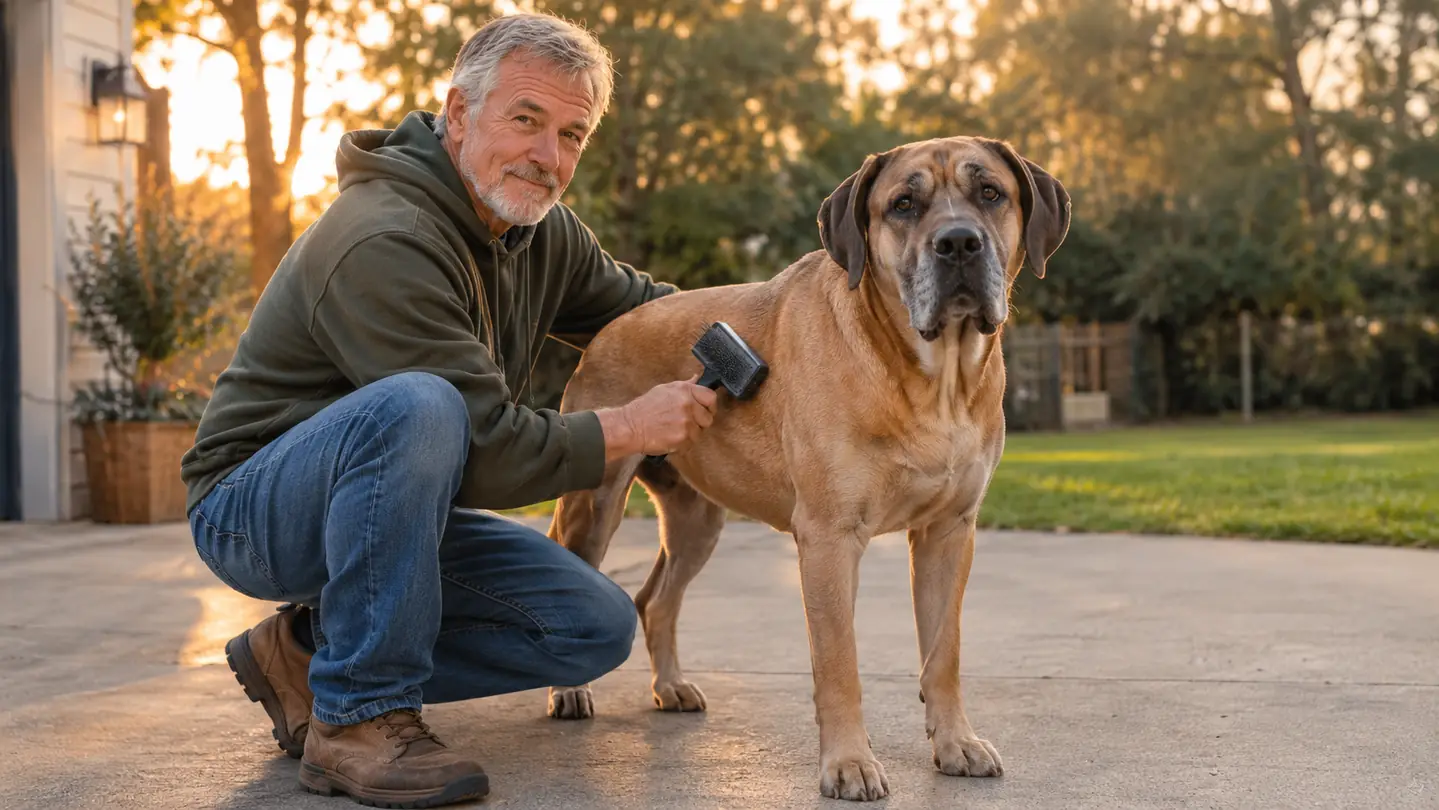
My truck looked like a dog had come apart in the passenger seat. Gunner is a 6-year-old boxer mix, about 68 pounds, and he has never once respected a season. He sheds in January the way he sheds in July. I bought the FURminator Large Dog Undercoat deShedding Tool for Short Hair because I was tired of vacuuming a vehicle that gets parked outside, and because a neighbor with a lab told me it was the only thing that ever worked on his. That is the honest origin of this review. No free sample, no arrangement with anybody, just a retired man and a shedding dog and a shop vac that was losing the argument.
What follows is the version I wish I had read before I ordered. The short version is that the tool works and I still use it every week, two years on. The longer version is that it took me about three weeks to stop using it wrong, and that the wrong way is the way most people use a grooming tool, which is to press down and drag like you are raking leaves. I did that. Gunner's coat along his left shoulder was thin for a while. So let me start with the part the listing bullets do not cover.
The Quick Verdict
It genuinely empties the undercoat on a short-coated dog over 50 pounds and cut my Sunday cleanup to twelve minutes. It also punishes a heavy hand, the metal handle is unforgiving, and it will not make a dog stop shedding.
Amazon Check Today's Price →The tool I still reach for every Sunday, two years in
Short hair version, built for dogs over 50 pounds. The FURejector button clears the blade with one thumb press so you are not picking hair out by hand between passes.
Amazon Check Today's Price on Amazon →What Nobody Tells You Before the First Stroke
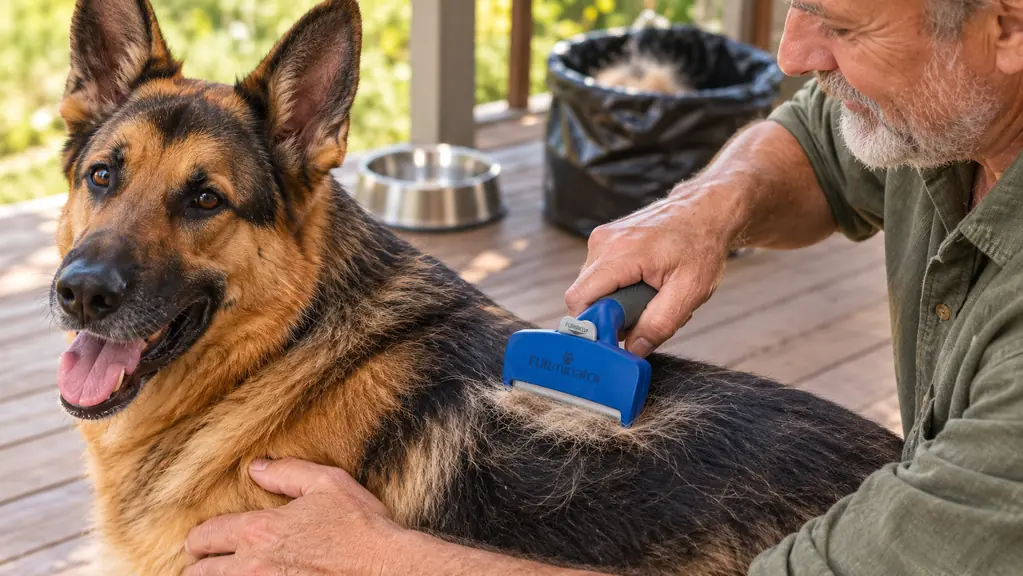
The business end of this thing is a row of stainless steel teeth set into a blade, and the blade sits at the end of a handle with a button on the back. That button is called the FURejector, and it pushes the collected hair off the edge in one pass. It is not a brush. It does not fluff anything. The teeth reach through the topcoat and take the loose undercoat out, and the listing itself says that happens without cutting skin or damaging the topcoat when used as directed. Those last four words are doing a lot of work, and almost nobody reads them.
Directed means the blade follows the lay of the coat and the tool moves in short, light strokes with the grain. Directed does not mean you bear down on a bony shoulder for two minutes because that is where the fur looks thickest. I know because that is exactly what I did on day one, on the concrete pad by the garage, with Gunner standing there being patient about it. He is a patient dog. He is less patient now that he knows what the tool is and what it means for him.
It was a Saturday in late October when I first used it, cool enough that I had a jacket on and Gunner was moving slow coming off the porch. I ran the tool down his left side three times without lifting it, then flipped it and went back up against the grain because I figured that would get more. It did get more. It got a lot more, and most of it was hair he needed. Three weeks later the shoulder still looked patchy in the sunlight, and the neighbor who recommended the tool asked what had happened to him. Nothing happened to him. I happened to him.
The other thing nobody mentions is how much comes off. The first session, I got a pile roughly the size of a second dog. I want to be clear that this is not because the tool is aggressive. It is because Gunner had two years of loose undercoat packed in there and nothing I owned had ever reached it. A slicker brush smooths the surface. This empties the drawer underneath it.
How I Actually Tested It
I groom Gunner on the back porch every Sunday afternoon, weather permitting, and I have done that since the week the tool arrived. Sunday because that is the day before trash pickup, so the fur goes straight into the bin instead of sitting in the garage. The routine is a five-minute pass along each side, a minute on the chest, and a couple of minutes on the back end where he carries the most of it. He gets a few treats and I get a porch I do not have to sweep twice. The whole thing takes maybe twelve minutes if he stands still and twenty if a delivery truck goes by.
For the first month I kept a tally on the back of an envelope, which sounds ridiculous until you remember I am the sort of man who keeps the manual for a coffee maker. Week one was four passes a side. Week four was two passes a side and the blade still came up loaded. By the end of that month the weekly pile had gone from something the size of a dinner plate to something the size of a softball, and it has held in that range ever since, with a spike every March and again in late September when his coat turns over.
Two years of that has taught me the tool's actual limits, which are not the limits the online arguments talk about. People fight over whether it is too harsh. Mine has never once nicked him. What it does to a coat depends entirely on whether the coat is the right type, and the listing is specific about that. This is the short hair version, and it says short hair because short hair is what it is built for. Gunner's coat is a short boxer-type coat with a dense underlayer, which is the exact case this tool was designed around. My neighbor's wirehaired terrier is a different conversation and I would not hand him this.
The weight is worth a mention because I am 61 and my hands are not what they were at 40. The tool runs about 7.84 ounces and measures roughly 2 by 6.5 by 8.75 inches. That is light enough that a twelve-minute session does not leave my wrist aching, which is more than I can say for the rake I used before. The handle is metal and it is not padded. If you have grip problems, that is a real consideration, and I will come back to it.
Twelve minutes on a Sunday, and the pile comes off the size of a second dog for the first month, then roughly a softball a week after that. That is the honest arithmetic.
The Part That Separates It From Every Brush I Owned
I have a drawer of grooming tools. A slicker, a rubber curry, a metal comb, and a rake with bent tines from a hardware store. Each of them does something, and none of them touched the undercoat. The slicker pulled surface hair and made the topcoat shiny and did nothing about the hair on the floor. The rake grabbed and pulled and Gunner walked away from it. The FURminator is the only one of the four that changed how much fur ended up in the truck, and it did it inside the first month.
The reason is geometry. The teeth are short, set close together in a line, and they comb through the topcoat and catch only what is already loose underneath. You are not pulling live hair out of a healthy dog. You are collecting hair that was on its way to your floor anyway, and getting it before it gets there. That is the whole idea and it holds up over two years of Sundays.
The button matters more than it sounds. Halfway through a pass, the blade loads up and stops catching anything. On the old rake, that meant stopping, digging the hair out with my fingers, and starting again. On this one, you press the FURejector with your thumb and the hair slides off the edge into the trash bag. It sounds like a small thing. Over twelve minutes and eight or nine passes, it is the difference between a chore you put off and a routine you keep.
What I Liked
- Actually reaches the undercoat on a short-coated dog over 50 pounds
- The FURejector button clears the blade with one thumb press instead of picking hair out by hand
- Light enough at 7.84 ounces for a full session without hand fatigue
- Cut my Sunday floor cleanup and truck vacuuming down to almost nothing
- Two years of weekly use and it has not nicked or scraped Gunner once
Where It Falls Short
- Pressing down or dragging against the coat will thin the fur, and it takes weeks to grow back
- Metal handle has no padding and gets slick when your hands sweat
- Built for short hair only, so it is useless on a wiry or long coat
- The blade edge has to stay clean and dry or it stops catching anything
- Does not slow shedding down, it only collects what has already come loose
Where It Falls Short
Two things bother me and I will not pretend otherwise. The first is the handle. It is metal, it is straight, and there is no give to it. On a cold morning in the garage it is unpleasant to hold, and by the end of a long session my thumb joint knows it. I wrapped mine in a strip of athletic tape after the first winter and that fixed it. I just should not have had to.
The blade itself needs more attention than I expected. It lives on a shelf in the garage now, teeth up and well away from the leash hook, because a bare row of stainless steel sitting in a bag with a lead and a pouch of treats is a bad idea. Once a month I wipe the edge with a dry cloth and pick anything packed between the teeth out with a toothpick. Skip that and the tool quietly stops catching hair. That is not a defect. It is what a close-set row of steel teeth does when it loads up with oil from the coat.
The second is the learning curve, which is steeper than the packaging suggests. There is no gauge, no depth setting, nothing that tells you when you are pressing too hard. You find out a week later when a patch of coat looks thin. For a tool aimed at dogs over 50 pounds, most of which belong to people old enough to have a back that complains, a bit more guidance in the box would have saved me and probably saved Gunner a thin shoulder.
And one honest limit: it does not make a dog stop shedding. Gunner still leaves fur on the couch. He still leaves it in the truck. What changed is the volume, and the fact that the fur I do find is loose stuff on the surface rather than the packed undercoat that used to mat against his skin in the summer. Anyone who tells you a tool stops shedding is selling something. This one manages it.
Why the Session Length Matters More Than You Think
Gunner has a little stiffness in his back hips on cold mornings. Nothing dramatic, just an old dog being an old dog. It matters here because grooming is standing still, and standing still on a cold concrete pad is the thing he likes least about the whole business. Before this tool, grooming him was a half-hour job and he would start shifting his weight about fifteen minutes in, which told me he was done before I was.
I learned that in his first spring with the tool. It was March, the coat was coming out in sheets, and I kept going because the pile was fascinating. Twenty-five minutes in he lay down on the concrete pad and would not get up, and I stood there with a blade in my hand feeling like a fool. Now I set a kitchen timer for twelve minutes and when it goes off we are done, whether I got both sides or not. The other side waits until next Sunday, and he has never once complained about that arrangement.
Twelve minutes is short enough that he does not get to that point. That is not a medical argument and I am not making one. It is just the practical reason session length matters to me, and why a tool that collects more in fewer passes earns its spot on the porch when the dog in front of you has a time limit. If your dog has the same kind of stiffness, work on a rug instead of concrete. Do one side, let him lie down for a minute, then do the other.
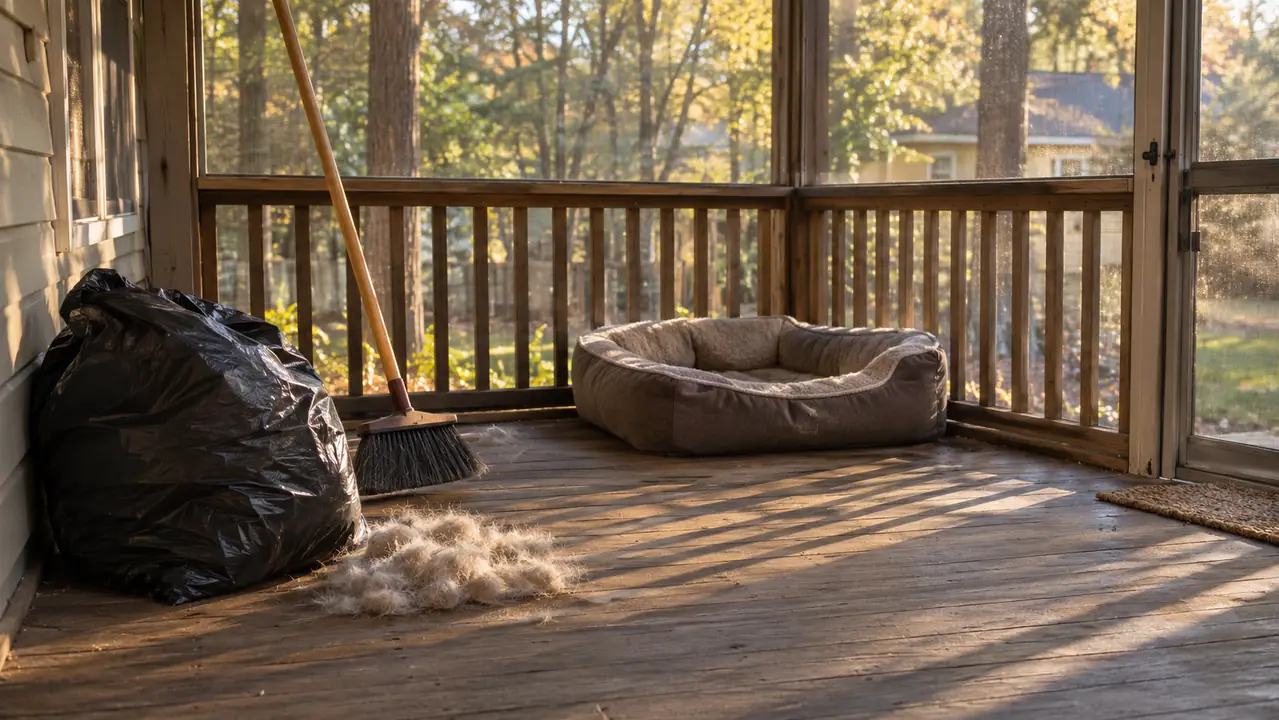
One more thing from two years of this: the fur goes everywhere. Not in a bad way, just in a way you should plan for. I keep a trash bag clipped to the porch rail and I work near it. The first few sessions I did it in the garage and I was sweeping that garage for a week.
Who This Is For
If you have a dog over 50 pounds with a short coat and a dense underlayer, this is the tool I would hand you first. Lab, boxer, pit mix, a shepherd with a shorter coat, anything in that range. If your dog sheds year round, if you have given up on the vacuum, if you have a back that does not love bending over a dog on the floor for half an hour, this cuts the session to twelve minutes on the porch and cuts the mess with it. And if you are the type who reads the label, you will have a better first month than I did.
Who Should Skip It
Skip it if your dog has a long coat, a curly coat, or a wiry coat. The short hair version is labeled short hair for a reason and there is a different tool for the other coats. Skip it if your dog will not stand still for ten minutes, because a moving target and a blade edge are a bad combination. Skip it if you want to groom your dog on your lap in front of the television, since this wants a floor or a porch where the fur can go somewhere. And skip it if you are not willing to use it lightly, because the one way this tool goes wrong is the way I made it go wrong.
What I Would Do Differently
Three things. I would start on a small patch on the flank rather than the shoulder, so I could see how much comes off before I committed to a whole side. I would follow the coat in short strokes from day one instead of trying to work out the angle by feel on a dog who was standing there trusting me. And I would buy a rubber curry to use first, because loosening the undercoat with the curry and then collecting it with the FURminator takes about half the passes.
The other thing I would do is set a calendar reminder. Once a week is enough after the first month. Skip three weeks in the spring and you are back to a pile the size of a second dog, and Gunner does not enjoy the long session any more than I do. Put it on the same day as something you already do, trash night for me, and it stops being a decision.
Two years, one thin patch, and it still lives on my porch rail
The short hair version. Dogs over 50 pounds. One thumb press clears the blade, and a full session fits inside twelve minutes.
Amazon Check Today's Price on Amazon →